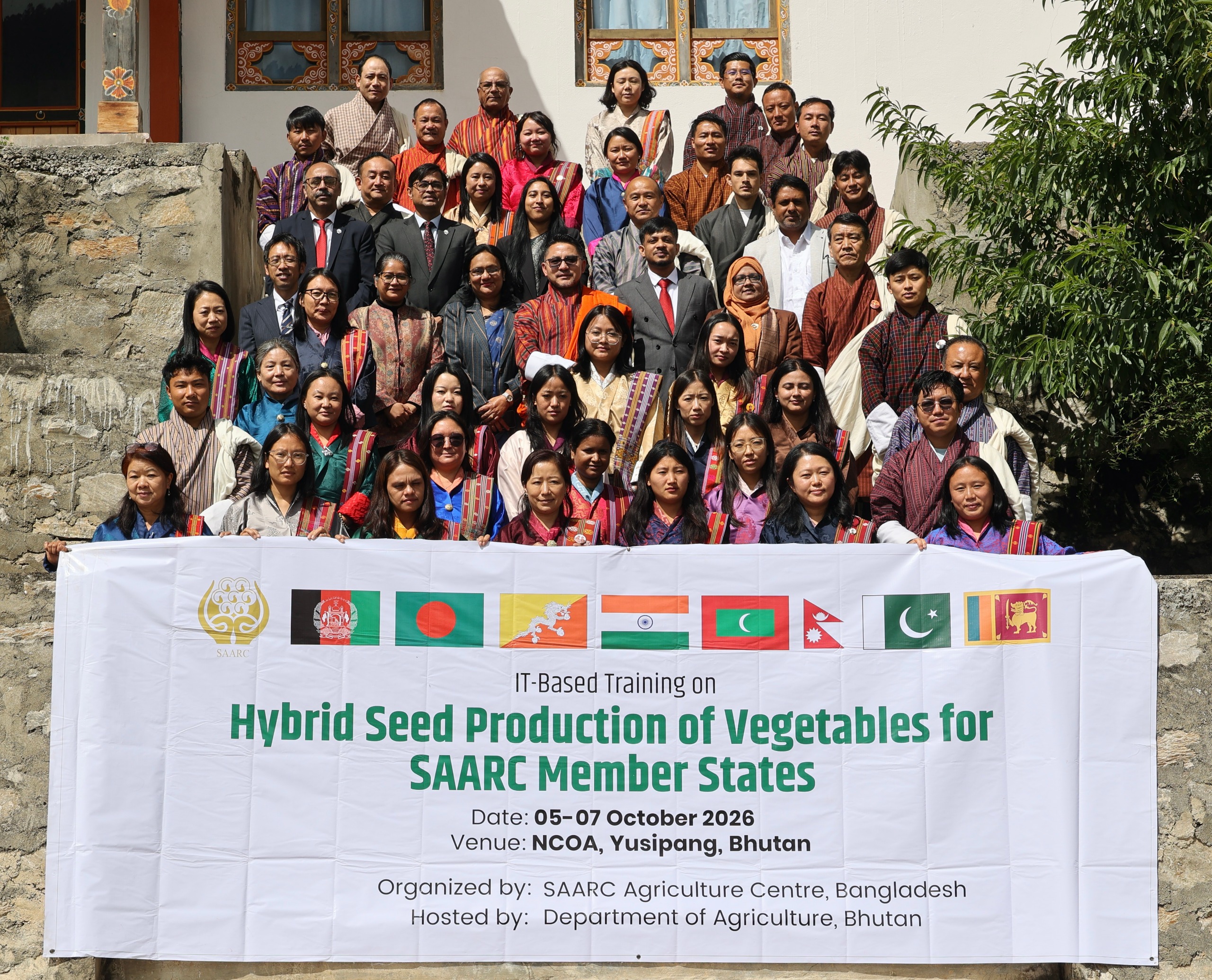
The Department of Agriculture, Ministry of Agriculture and Livestock, Royal Government of Bhutan in collaboration with the SAARC Agriculture Centre (SAC), Dhaka, Bangladesh, is hosting a three-day Regional IT-based Training on “Hybrid Seed Production of Vegetables for SAARC Member States” from 5–7 October 2026 at the National Centre for Organic Agriculture (NCOA), Yusipang, Bhutan, in hybrid mode.
The event commenced today, 5 October 2026, with an inaugural session graced by H.E. Lyonpo Younten Phuntsho, Hon’ble Minister, Ministry of Agriculture and Livestock, Royal Government of Bhutan, as the Chief Guest, and Mr. Tanvir Ahmad Torophder, Director (ARD & SDF), SAARC Secretariat, Kathmandu, Nepal, as the Special Guest. The inaugural ceremony was also attended by distinguished diplomatic representatives, including H.E. Ms. Maleka Parveen, Ambassador of Bangladesh to Bhutan; Ms. Neha Yadav, First Secretary, Embassy of India in Bhutan; the Director General, Department of Multilateral Affairs, Ministry of Foreign Affairs and External Trade, along with officials from the SAARC Secretariat, SAARC Agriculture Center, Department of Agriculture, resource persons, 30 researchers from Bhutan attending in-person and two each participants from other SAARC member states (Bangladesh, India, Nepal and Sri Lanka) attending virtually.
In the inaugural address, the Chief Guest, H.E. Lyonpo Younten Phuntsho, highlighted the vital role of plant breeding, hybrid vigour and quality seed systems in enhancing agricultural productivity, food and nutrition security, and resilience to climate variability, pests and diseases. He emphasized that investment in seed technology, research and human capacity must translate into tangible benefits for farmers through improved varieties, accessible technologies, and reliable seed systems. He stressed that the ultimate measure of success is improved yields, reduced risks, better market opportunities and increased farmer incomes and livelihoods.
The training is particularly relevant to the region given the importance of vegetables for food and nutrition security. Vegetables are important sources of vitamins, minerals, dietary fibre and other beneficial compounds, while increasing vegetable productivity is essential to meet the nutritional needs of a growing population.
However, access to quality hybrid seed remains a challenge in many parts of South Asia. Strengthening local capacity in hybrid seed production can therefore contribute not only to improved availability of quality seed, but also to reducing dependence on imported hybrid seed and strengthening domestic seed systems.
The programme combines technical lectures, hands-on exercises, laboratory and field demonstrations, and group learning. The technical sessions focus particularly on hybrid seed production of tomato and chilli, including the principles and techniques involved in hybrid seed production, parent plant management, emasculation, pollination, genetic purity, seed handling, storage and quality control.
The training will ensure that advances in hybrid seed technology contribute to farm-level impact enabling farmers to access better-quality seed, improve productivity and produce more uniform and marketable vegetables, while strengthening resilience, profitability and livelihoods.